
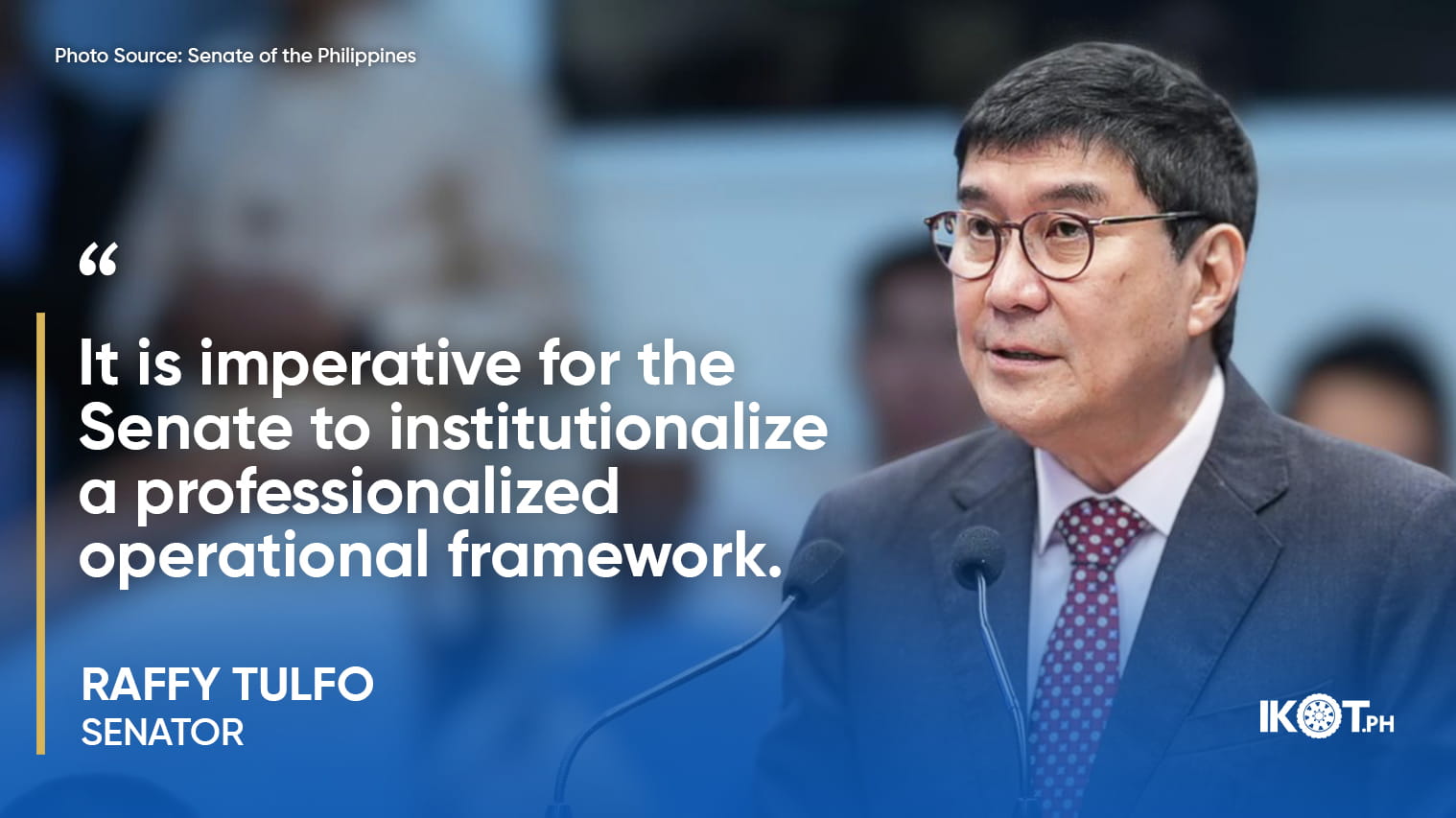
Senator Raffy Tulfo filed a Senate resolution seeking to urge the Senate Office of the Sergeant-at-Arms to undertake comprehensive capacity-building training programs and to develop and institutionalize a formal operations manual to ensure effective security operations within the Senate of the Philippines.
In filing Senate Resolution (SR) No. 402, Tulfo highlighted operational, coordination, and procedural concerns relating to internal security protocols, emergency response measures, perimeter control, inter-agency coordination, and command responsibility during the reported confrontation and operational standoff between members of the National Bureau of Investigation (NBI) and OSAA personnel inside Senate premises last May 13.
“Reports regarding confusion during the incident underscore the necessity for clearer operational standards, updated coordination mechanisms, and institutionalized protocols.”
“Reports regarding confusion during the incident, including alleged warning shots, lockdown procedures, movement control, and differing accounts from involved parties, underscore the necessity for clearer operational standards, updated coordination mechanisms, and institutionalized protocols governing interactions between the OSAA and external law enforcement agencies,” the legislator said.
Suspended Senate Sergeant-at-Arms PMGen. Mao Aplasca (Ret.) reportedly claimed that the warning shot he fired during the confrontation between Senate security personnel and law enforcement authorities is an effort to prevent escalation and avoid a possible “bloodbath”.
“The OSAA is not covered by the Revised Philippine National Police Operational Procedures Manual because they are not included under the command and supervision of the PNP.”
Meanwhile, former Philippine National Police Chief PGen. Nicolas Torre III explained that Aplasca and the OSAA are not covered by the Revised Philippine National Police Operational Procedures Manual because they are not included under the command and supervision of the PNP.
Tulfo said that it only emphasized “the operational and regulatory gap arising from the absence of a separate, clearly defined, and institutionalized operations manual specifically governing the Office of the Sergeant-at-Arms and its personnel.”
As such, the lawmaker said: “It is imperative for the Senate to institutionalize a professionalized operational framework that clearly defines protocols, command responsibility, communication systems, use-of-force guidelines, emergency procedures, evacuation procedures, coordination mechanisms with law enforcement agencies, and standards of conduct for all OSAA personnel.”
“Regular and specialized training programs, including but not limited to crisis and crowd management, emergency response, de-escalation techniques, parliamentary security management, incident documentation, lawful enforcement coordination, and human rights-based security operations, are necessary to strengthen the capability, professionalism, and credibility of the OSAA,” the senator added.
Ultimately, he proposed that the Office of the Sergeant-at-Arms be encouraged to coordinate with relevant government agencies, law enforcement institutions, emergency response units, constitutional experts, and security professionals in the updating of its existing manual and the formulation of best practices and operational standards consistent with constitutional rights, public safety principles, and parliamentary security protocols.