
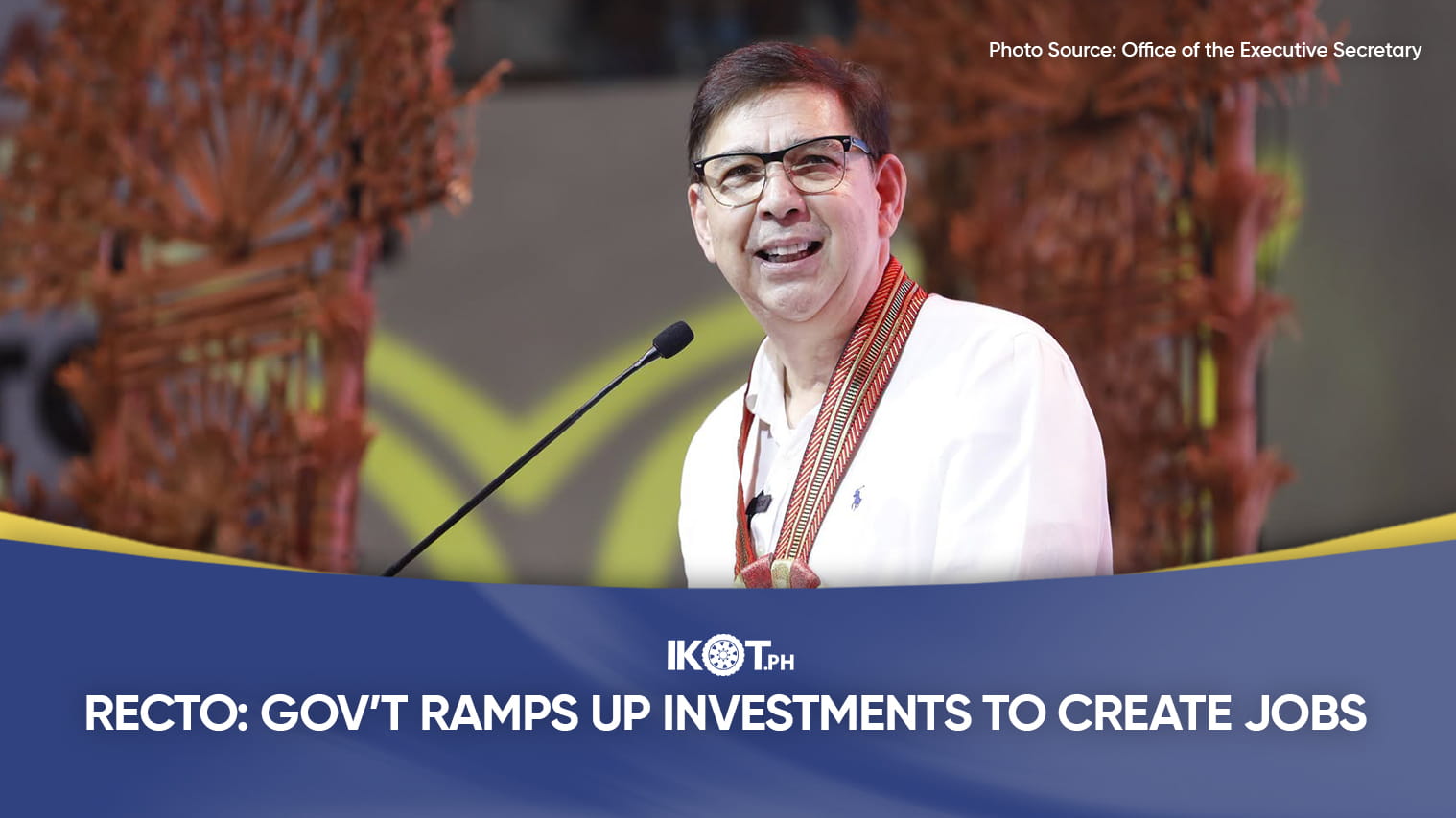
Executive Secretary Ralph Recto said the government will fast-track investments, strengthen skills training, and help businesses expand and hire more Filipinos as July labor figures indicated mixed results.
The July 2026 Labor Force Survey (LFS) showed that 49.2 million Filipinos were employed, approximately 3.2 million more than a year earlier.
Private establishments added 582,000 wage and salary workers, while middle- and high-skilled occupations posted a combined increase of approximately 2.6 million workers. However, unemployment rose to 6%, with 3.14 million Filipinos unemployed or 551,000 more than a year earlier.
“More Filipinos are finding work but more are also entering the labor force so job creation must keep pace.”
“More Filipinos are finding work but more are also entering the labor force so job creation must keep pace. Kaya kailangan nating pabilisin ang pagpasok ng mga investments, tulungan ang mga negosyo na lumago at kumuha ng mas maraming manggagawa, at ihanda ang mga Pilipino sa mga trabahong nagbubukas,” Recto said.
The government is moving on multiple fronts to expand employment opportunities and ensure that Filipinos are prepared for higher-value jobs.
It recently launched the Philippine Semiconductor and Electronics Industry (PSEI) Roadmap to expand the country’s manufacturing base and create more skilled jobs. The roadmap seeks to move the Philippines beyond traditional assembly and manufacturing and capture more high-value activities, including chip design, engineering, research, and innovation.
The Marcos administration also approved 46 special economic zones projected to attract P141.2 billion in investments and generate close to 189,000 jobs.
Of these, 43 are outside Metro Manila, supporting the administration’s push to bring investments and employment to the countryside. By island group, 29 are in Luzon, 12 in the Visayas, and five in Mindanao.
“Inilalapit natin ang trabaho sa mga Pilipino. Hindi dapat kailangan lumayo sa pamilya o lumipat sa ibang lugar para lamang magkaroon ng magandang hanapbuhay,” Recto stressed.
The government is also accelerating the rollout of Luzon Economic Corridor (LEC), which will connect Subic, Clark, Manila, and Batangas into a major hub for logistics, manufacturing, and innovation. The corridor is envisioned to generate up to one million jobs.
Within this broader development area, a planned 1,600-hectare technology hub in New Clark City is expected to support semiconductors, advanced manufacturing, and artificial intelligence, with a projected 130,000 high-quality jobs.
Recto stressed that these investments must be matched by training that prepares Filipinos for the positions being created.
President Ferdinand Marcos Jr. and Recto graced the first anniversary of the JERA-AboitizPower Global Technical Center of Excellence (GTCOE), a regional training hub for power plant operations and maintenance.
Since its launch in September 2025, 79 Filipino and Japanese engineers and technical professionals have already completed the center’s Operations and Maintenance Basic Program. Its training programs have extended to operating power facilities in Bataan and Quezon.
They also visited the Batangas State University LIMA Campus, established in partnership with Aboitiz Economic Estates to develop industry-ready talent. The campus offers 10 undergraduate engineering programs, eight graduate programs, and industry micro-credentials. It welcomed 800 first-year engineering students in August 2026.
The administration is also pursuing measures to help workers keep more of their earnings and give businesses more room to expand.
It is proposing to raise the annual personal income tax exemption threshold to P350,000, which would allow qualified taxpayers to take home up to P17,500 more each year.
The administration is likewise pushing to exempt microenterprises from the 2% minimum corporate income tax (MCIT), providing additional relief to MSMEs and helping them preserve capital for expansion and hiring.
“The proposed P7.2-trillion national budget for 2027 will likewise protect employment gains.”
Recto said the proposed P7.2-trillion national budget for 2027 will likewise protect employment gains and ensure that economic progress translates into concrete benefits for Filipino families.
Equivalent to 21.7% of GDP, the spending plan prioritizes education, health, social protection, food security, infrastructure, employment, and disaster resilience.
The Executive is working closely with Congress to pass the budget on time, improve spending execution, and accelerate high-impact infrastructure projects that will create a high multiplier effect on the economy in terms of creating jobs.