
A pivotal measure seeking to resolve the fragmented governance of the Philippine education system has been filed in the House of Representatives, directly responding to the critical findings of the Second Congressional Commission on Education (EDCOM II).
House Bill No. 9006, officially titled the “National Coordinating Council for Education (NCCE) Act,” was introduced by Second Congressional Commission on Education Co-Chairperson Representative Roman Romulo.
The proposed legislation seeks to create a permanent inter-agency body under the Office of the President to direct, coordinate, and monitor education and workforce development reforms across the Executive Branch.
“Fragmentation must give way to convergence to ensure equitable access to quality education for all Filipinos.”
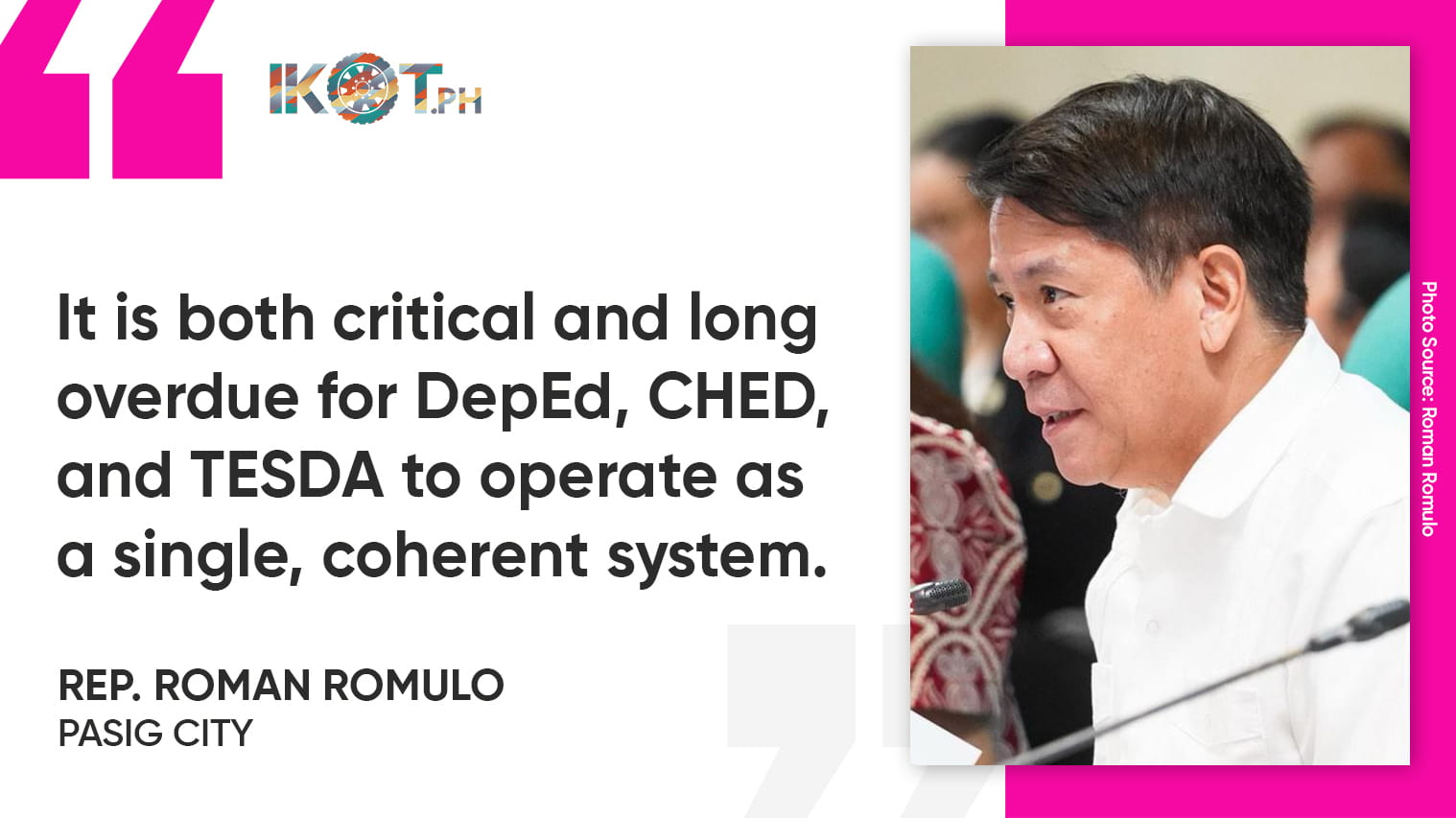
“It is both critical and long overdue for DepEd, CHED, and TESDA to operate as a single, coherent system. Fragmentation must give way to convergence—through aligned mandates, shared priorities, coordinated funding, and unified implementation—to ensure equitable access to quality education for all Filipinos,” EDCOM 2 co-chairperson Romulo said.
“In this regard, the establishment of the NCCE is indispensable to drive coherence, accountability, and sector-wide effectiveness,” the veteran legislator added.
“The country’s learning crisis is not merely programmatic, but systemic.”
The seasoned lawmaker’s filing of the bill addresses a key observation made by EDCOM II: the country’s learning crisis is not merely programmatic, but systemic.
In its year reports, EDCOM II highlighted that the trifocalization of education governance across the Department of Education (DepEd), the Commission on Higher Education (CHED), and the Technical Education and Skills Development Authority (TESDA) has resulted in policy incoherence, duplication of efforts, and gaps in accountability. The Commission further noted that the absence of a central coordinating mechanism has historically led to misaligned priorities, inefficient use of resources, and a discontinuity of reforms across different administrations.
To address these systemic gaps, HB 9006 mandates the creation of the NCCE, which will be chaired by the President of the Philippines. By placing the council under the Office of the President, the bill acts on EDCOM II’s recommendation to strengthen whole-of-government coordination, which is critical for addressing interconnected issues such as teacher quality, curriculum coherence, education pathways, and school-to-work transitions.
Under the proposed measure, the NCCE will serve as the primary platform to harmonize reforms, oversee implementation, and sustain long-term education priorities. Specifically, the council’s mandate includes formulating and updating a National Education and Workforce Development Plan to ensure coherence in targets, priorities, and resource allocation. Furthermore, it will track the implementation of major education and workforce development reforms, explicitly including the recommendations made by EDCOM II. The NCCE is also tasked with overseeing the development of a comprehensive human resource plan covering both teaching and non-teaching personnel, strengthening the labor market information system to guide education and training decisions, and directing the establishment and maintenance of an interoperable data system to track learner progress across relevant agencies.
The council will gather high-level officials, with the President serving as Chairperson and the authority to designate a Cabinet Secretary as Vice Chairperson to oversee operational coordination. The council’s members will include the heads of DepEd, CHED, TESDA, the Department of Science and Technology (DOST), the Department of Labor and Employment (DOLE), the Department of Budget and Management (DBM), the Department of Economy, Planning, and Development (DEPDev), the National Commission for Culture and the Arts, and the Philippine Sports Commission.
Through the consolidation of inter-agency coordination, rationalizing overlapping bodies, and instituting a results-based monitoring and evaluation framework, HB 9006 aims to enhance accountability, improve efficiency, and ensure that reforms translate into measurable learning gains and better employment outcomes.