Continuing the Duterte legacy on free tertiary education, the Senate approved on second reading Senate Bill No. 1894, or the proposed Enhancing Universal Access to Quality Tertiary Education Act, a measure authored and co-sponsored by Senator Bong Go that seeks to strengthen Republic Act No. 10931 (RA 10931), or the Universal Access to Quality Tertiary Education Act, by expanding support for poor and disadvantaged Filipino students pursuing college and technical-vocational education.
Go’s support for the measure is also rooted in his role during the enactment of RA 10931 in 2017, when he was serving as Special Assistant to the President (SAP) to then president Rodrigo Duterte.
The veteran legislator has recalled that the free tertiary education measure nearly faced a veto after finance managers raised concerns over its funding requirements, but as SAP, he helped push for its signing and urged the Commission on Higher Education (CHED) to defend the measure.
During recent plenary discussions, Senate Majority Leader Migz Zubiri also recalled being in Cebu when he learned that RA 10931 had been signed, saying he cried with joy because he considered it one of the major education measures of the Duterte presidency.
“Noon pa man, ipinaglaban na natin na mabigyan ng pagkakataon ang bawat Pilipinong makapag-aral, lalo na ang mahihirap nating kababayan.”
“Alam natin kung gaano kahalaga ang edukasyon sa kinabukasan ng kabataan. Noon pa man, ipinaglaban na natin na mabigyan ng pagkakataon ang bawat Pilipinong makapag-aral, lalo na ang mahihirap nating kababayan,” Go said.
RA 10931 provides free tuition and other school fees in State Universities and Colleges (SUCs), Local Universities and Colleges (LUCs), and state-run Technical-Vocational Institutions (TVIs). It also established the TES and student loan program to help students cover other education-related expenses.
The proposed amendatory measure seeks to refine the law by giving stronger focus to learners from disadvantaged backgrounds, including persons with disabilities, Indigenous Peoples, learners under foster care, children at risk, children in conflict with the law, solo parents and their dependents, learners from Pantawid Pamilyang Pilipino Program (4Ps) households, first-generation tertiary learners, learners from geographically isolated and disadvantaged areas, and other vulnerable sectors.
Under the bill, senior high school graduates from 4Ps households, once certified by the Department of Social Welfare and Development (DSWD), shall automatically qualify as TES beneficiaries upon admission to a Commission on Higher Education (CHED)-recognized higher education institution or Technical Education and Skills Development Authority (TESDA)-recognized TVI.
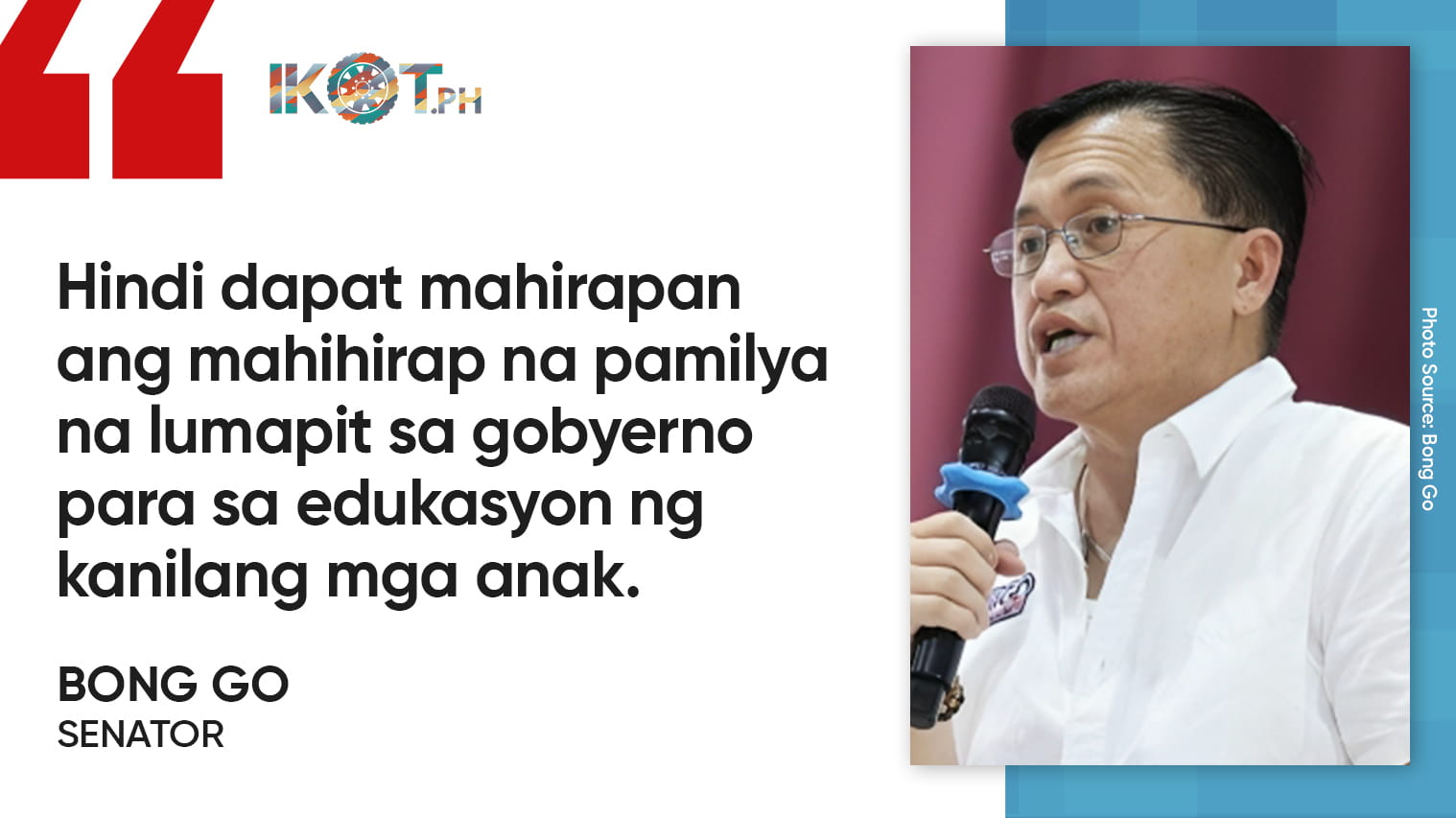
“Ang importante dito, masigurado nating ang tulong ay mapupunta sa mga estudyanteng mas nangangailangan. Hindi dapat mahirapan ang mahihirap na pamilya na lumapit sa gobyerno para sa edukasyon ng kanilang mga anak,” the seasoned lawmaker emphasized.
SBN 1894 also seeks to expand the coverage of “other school fees” by including clinical internship and Related Learning Experience (RLE) fees required by nursing and other allied health programs. This provision aims to help students whose degree programs require practical training outside the classroom.
The measure also broadens the possible coverage of TES benefits to include tuition and school fees in private higher education institutions and private TVIs, books, supplies, transportation, computer or laptop rental or purchase, room and board, disability-related expenses, clinical internship and RLE fees, additional allowances for disadvantaged learners, and one-time costs for professional credentials or qualifications.
Go said education support must respond to the actual needs of students, particularly those who struggle with costs beyond tuition.
“Maraming estudyante ang libre nga ang tuition, pero nahihirapan pa rin sa pamasahe, gamit sa eskwela, tirahan, pagkain, at iba pang gastusin. Kaya dapat mas tingnan natin ang tunay na kalagayan nila,” he stressed.
The bill also requires SUCs, LUCs, and state-run TVIs to develop and publicly disclose an Equity and Inclusion Plan, including annual equity admission targets and contextual admissions criteria for learners from disadvantaged backgrounds.
To protect qualified beneficiaries, SBN 1894 provides that once a TES amount has been awarded to a student, the amount shall not be reduced. The Unified Student Financial Assistance System for Tertiary Education (UniFAST) Board shall also review and adjust TES amounts every two years, in consultation with CHED, TESDA, and the Department of Budget and Management, to take into account inflation and changes in education costs.
The measure likewise provides for monitoring and validation systems, streamlined disbursement mechanisms to prevent undue delay, learner support services, impact evaluation studies, and sanctions for institutions that fail to comply with minimum quality standards.
Go stressed that transparency and accountability should remain central in the implementation of student assistance programs.
“Dapat malinaw ang proseso, mabilis ang pag-release, at may pananagutan ang lahat ng nagpapatupad. Pondo ito ng taumbayan, kaya dapat makarating ito nang tama at maayos sa mga estudyanteng dapat makinabang,” he said.
“Pondo ito ng taumbayan, kaya dapat makarating ito nang tama at maayos sa mga estudyanteng dapat makinabang.”
The proposed amendments come as lawmakers continue to assess how RA 10931 can be strengthened to better reach students from low-income families, particularly those whose ability to continue tertiary education depends on timely and sufficient government assistance.
Go said he will continue supporting measures that make education more accessible to ordinary Filipinos, especially students from poor and vulnerable families.
“Ang edukasyon ay isa sa pinakamahalagang paraan para mabigyan ng mas magandang kinabukasan ang kabataan. Kung kaya nating tulungan sila ngayon, gawin na natin. Serbisyo po ito para sa kanilang pamilya at sa kinabukasan ng ating bayan,” he concluded.